English
 français
 Deutsch
 Español
 português
 العربية
Removing Micropollutants, PFAS, and Industrial Contaminants through Targeted Adsorption
Date: July 9th, 2026
Author: Yicarb Technical Expert
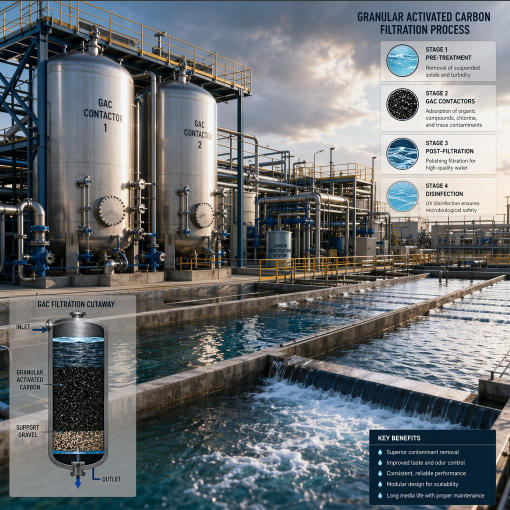
Figure 1: Industrial visualization of a municipal GAC filtration facility for advanced drinking water treatment.
Abstract: Water scarcity and tightening regulatory standards demand advanced treatment solutions beyond conventional filtration. Activated carbon remains the most versatile and scalable adsorption technology for removing organic micropollutants, disinfection by-product precursors, and emerging contaminants such as PFAS. This technical brief examines the pore-engineering principles behind high-performance water treatment carbon and presents two global case studies demonstrating measurable operational outcomes.
Effective water treatment demands a multi-barrier approach. Activated carbon contributes two distinct removal mechanisms:
• Physical Adsorption (van der Waals forces): Organic molecules diffuse into the carbon’s internal pore structure and adhere to the graphitic basal planes. The oleophilic nature of a clean carbon surface preferentially attracts non-polar organic contaminants over water molecules, making it exceptionally effective for removing taste-and-odor compounds, pesticides, and industrial solvents.
• Catalytic/Reductive Removal: Certain activated carbons can catalytically decompose free chlorine and chloramines, converting them to chloride ions without generating harmful by-products. This dual functionality eliminates the need for separate dechlorination chemicals in downstream processes such as reverse osmosis.
YICARB engineers the hierarchical pore distribution to match the target contaminant profile:
• Micropores (< 2 nm): Capture low-molecular-weight compounds such as trihalomethanes (THMs), volatile organic compounds (VOCs), and short-chain PFAS (e.g., PFBA, PFBS).
• Mesopores (2–50 nm): Essential for adsorbing larger molecules including humic substances, long-chain PFAS (PFOA, PFOS), and pharmaceutical residues.
• Macropores (> 50 nm): Facilitate rapid hydraulic throughput and provide access pathways for biofilm colonization in biologically active carbon (BAC) filters.
Indicator | Standard | Engineering Significance |
Iodine Number | 900–1200 mg/g | Correlates with total micropore volume; predicts removal efficiency for THMs, taste & odor. |
Molasses Number | 200–400 | Measures mesopore capacity for humic acid and color-body removal. |
Abrasion Number | > 75 | Ensures mechanical integrity during backwashing cycles; minimizes carbon loss. |
Effective Size | 0.55–0.75 mm | Controls head loss and contact time; critical for GAC contactor design. |
Ash Content | < 5% | Low ash prevents leaching of metals into treated water; essential for food-grade compliance. |
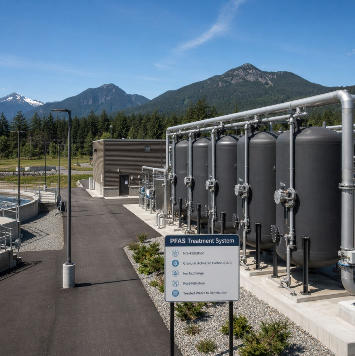
Figure 2: Municipal drinking water treatment facility with GAC contactors for PFAS removal.
Operational Challenge: A mid-sized municipality in the US Midwest serving 180,000 residents received a regulatory mandate to reduce PFOA and PFOS levels to below 4.0 ng/L (the EPA’s National Primary Drinking Water Regulation limit). Source water analysis revealed PFAS concentrations of 22 ng/L, primarily from upstream industrial discharge. The existing conventional treatment train (coagulation, flocculation, sedimentation, filtration) showed negligible PFAS removal.
The YICARB Solution: We designed and supplied YICARB AquaGuard GAC (8×30 mesh, Iodine Number 1050 mg/g) in a lead-lag contactor configuration with 15-minute empty bed contact time (EBCT). The high micropore volume and controlled effective size ensured consistent diffusion kinetics across the filter bed. After 12 months of continuous operation, effluent PFAS levels stabilized below the detection limit (< 2.0 ng/L), achieving 100% regulatory compliance. The GAC bed life was extended to 18 months through YICARB’s optimized activation protocol, reducing annual media replacement costs by 22% compared to competing activated carbon suppliers. For facilities targeting similar compliance outcomes, granular activated carbon for PFAS removal provides a proven pathway to meet stringent regulatory limits.
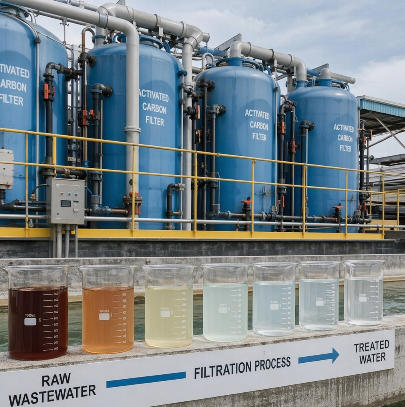
Figure 3: Textile dyeing wastewater treatment facility utilizing YICARB mesoporous carbon for color removal.
Operational Challenge: A large textile dyeing and finishing facility in Bangladesh was under pressure to meet Zero Liquid Discharge (ZLD) targets. Their secondary biological treatment could only reduce COD to 280 mg/L and produced an effluent with deep blue-green coloration (Pt-Co color > 500 units). The local environmental authority mandated discharge limits of COD < 50 mg/L and color < 20 Pt-Co units.
The YICARB Solution: We deployed YICARB ColorGuard GAC (12×40 mesh, Molasses Number 380), a coal-based carbon specifically engineered for enhanced mesopore distribution. The expanded mesopore network (2–20 nm) provided accessible surface area for large chromophoric dye molecules that were sterically excluded from microporous-only carbons. A fixed-bed adsorption column system was installed downstream of the existing MBR (Membrane Bioreactor).
The results were transformative:
• COD reduced from 280 mg/L to 32 mg/L (89% reduction).
• Color reduced from >500 Pt-Co to 8 Pt-Co units (98.4% removal).
• Treated water was successfully reused in the dyeing process, reducing freshwater withdrawal by 35% and saving approximately USD 180,000 annually in water procurement and discharge fees.
Water treatment challenges are becoming increasingly complex, driven by emerging contaminants, stricter regulations, and resource scarcity. Activated carbon remains the gold standard in adsorption technology because it is scalable, predictable, and tunable to specific contaminant profiles. Whether addressing PFAS in municipal drinking water or industrial color and COD in manufacturing effluent, the performance outcome is determined by matching the carbon’s pore architecture to the molecular characteristics of the target pollutant.
YICARB’s engineered GAC solutions combine rigorous quality control, precise particle sizing, and application-specific activation protocols to deliver reliable, cost-effective water treatment outcomes across municipal and industrial sectors worldwide. As a trusted activated carbon supplier, YICARB provides comprehensive technical support and lot-certified documentation for activated carbon for wastewater treatment applications.