English
 français
 Deutsch
 Español
 português
 العربية
Activated carbon for industrial wastewater treatment is often specified with a strong focus on iodine value, yet real treatment performance depends on a much wider set of factors. The contaminant profile, pore-size distribution, carbon form, particle size, contact time, competing organics, upstream treatment, and operating configuration all influence adsorption behavior. This technical brief explains why carbon selection should begin with the wastewater and process objective rather than with a single specification. It also outlines how granular activated carbon (GAC) and powdered activated carbon (PAC) fit different treatment strategies, which supplier data are useful during evaluation, and how an application-based approach can reduce the risk of underperforming carbon in industrial polishing systems.
The first question in activated carbon selection should be: what must be removed, and under what process conditions? Industrial wastewater can contain residual dissolved organics, color bodies, odor-causing compounds, trace adsorbable contaminants, surfactants, oils, and background dissolved matter. These species differ in molecular size, polarity, concentration, and affinity for carbon surfaces. A product that performs well on one wastewater can therefore perform very differently on another.
This is why activated carbon for wastewater treatment should be selected around a treatment objective. The role may be final polishing after biological treatment, removal of a specific organic fraction, color reduction, protection of a downstream membrane or ion-exchange step, or temporary support during a process upset. Each role creates different priorities for adsorption capacity, kinetics, particle form, and replacement strategy.
Iodine value is a useful quality-control indicator because it reflects adsorption of relatively small molecules under a standardized test condition. It can help compare batches and provide a quick indication of developed microporosity. However, it is not a direct prediction of how a carbon will remove every contaminant from industrial wastewater.
Real wastewater contains mixtures rather than a single test compound. Larger organic molecules may depend more heavily on mesopore accessibility; competing dissolved organics can occupy adsorption sites; suspended matter can foul the external surface; and short contact time can prevent equilibrium capacity from being reached. Two carbons with similar iodine values can therefore behave differently in the same system if their pore architecture, surface chemistry, particle size, or manufacturing consistency differ.
Use iodine value as one part of product screening and batch control. Do not treat it as a stand-alone ranking of overall wastewater treatment performance.
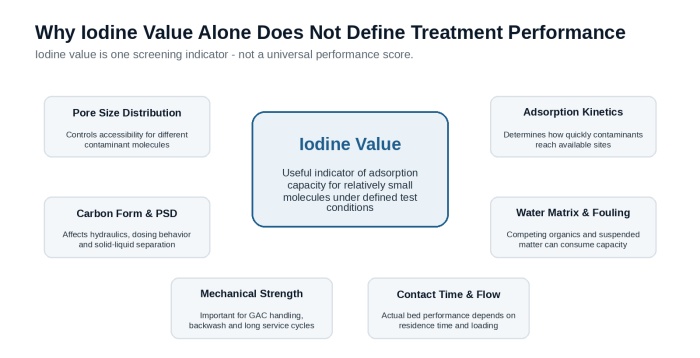
Figure 1: Iodine value is one screening indicator; pore structure, kinetics, carbon form, wastewater matrix, mechanical strength, and contact time also influence treatment performance.
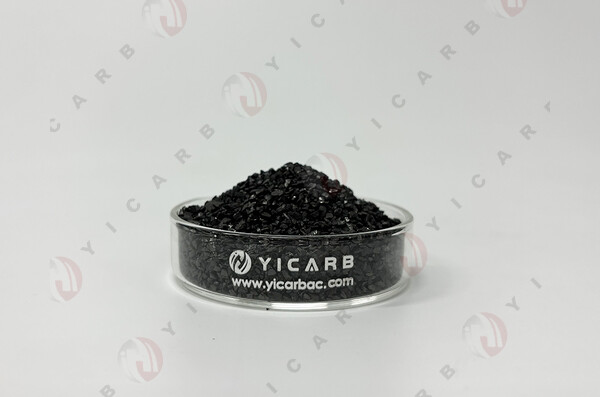
Granular activated carbon is commonly used in fixed-bed adsorbers, pressure vessels, gravity filters, and polishing columns. In these systems, carbon must provide both adsorption performance and acceptable hydraulic behavior. Particle size distribution influences pressure drop and mass transfer, while mechanical strength becomes important during loading, backwashing, transport, and repeated handling.
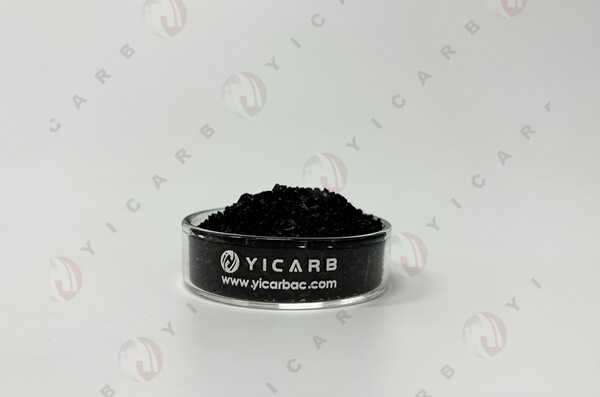
Powdered activated carbon is dosed directly into water or a treatment stage and is later separated with sludge or another solid-liquid separation process. It can be useful when operators need flexible dosing, temporary treatment support, or rapid response to changing contaminant loads. PAC selection therefore involves not only adsorption capacity but also dispersion, dosing control, contact time, and separation behavior.
Coconut shell, coal, and wood-based carbons can develop different pore structures and physical properties, but raw-material labels alone should not determine the purchase decision. The relevant question is whether the finished carbon provides the pore accessibility, particle characteristics, strength, and consistency needed for the intended wastewater and process configuration.
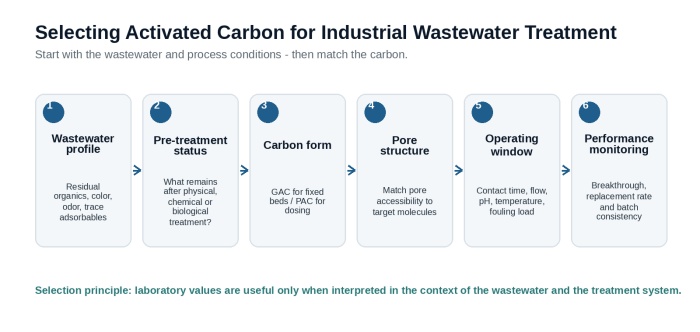
Figure 2: A practical activated carbon selection pathway for industrial wastewater treatment.
Even a technically suitable carbon can underperform if the operating window is poorly matched. Contact time determines how much opportunity contaminants have to diffuse into the pore network. Flow distribution affects whether a fixed bed uses its full depth or develops preferential channels. High suspended solids can block external surfaces, while heavy background organic loading can consume capacity before the target contaminant is fully controlled.
For GAC systems, empty-bed contact time, superficial velocity, bed depth, backwash conditions, influent variability, and replacement or regeneration strategy should be considered together. For PAC, dose, mixing intensity, contact time, downstream clarification or filtration, and sludge management become part of the performance equation. Activated carbon selection is therefore inseparable from process design and operation.
Application Example - not a customer case study: Consider a manufacturing facility where biological treatment removes most biodegradable load, but the final effluent still contains a variable residual organic fraction and occasional color. The operating team is evaluating activated carbon as a polishing step before discharge or reuse.
A high iodine value alone would not answer the key questions. The team would first characterize the residual organics and determine whether continuous fixed-bed treatment or flexible PAC dosing better matches the variability. If GAC is selected, the evaluation should include pore structure, particle size distribution, hydraulic behavior, mechanical strength, and expected breakthrough. If PAC is selected, the focus shifts toward adsorption kinetics, dose-response behavior, mixing, and downstream solids separation.
The value of the example is the decision process: the carbon is chosen to fit the remaining contaminant load and treatment configuration, rather than to maximize a single specification on a data sheet.
A useful supplier evaluation combines product data with evidence of manufacturing and quality-control consistency. Depending on the carbon type and application, industrial buyers may request:
Iodine value and, where relevant, BET surface area as supporting adsorption indicators.
Particle size distribution appropriate for the selected GAC or PAC application.
Ash and moisture data to understand product composition and handling consistency.
Mechanical strength or hardness data for granular products that will be transported, backwashed, or repeatedly handled.
Batch-specific quality documentation such as a Certificate of Analysis (COA).
Information on raw-material control, activation, grading, final inspection, and batch-to-batch consistency.
For difficult wastewater, bench-scale or pilot evaluation can provide more application-specific information than specification comparison alone. The purpose is not to find the carbon with the highest number; it is to identify the carbon that delivers suitable removal behavior under the actual process conditions.
YICARB approaches industrial activated carbon selection by connecting product characteristics with operating requirements. For wastewater applications, this means considering the target contaminants, treatment stage, carbon form, pore structure, particle size distribution, mechanical requirements, and process conditions as a complete system rather than isolated parameters.
Consistent manufacturing and quality control are especially important where a treatment system depends on predictable carbon replacement intervals or stable fixed-bed hydraulics. Product data should therefore support, not replace, application evaluation.
Iodine value remains useful for activated carbon quality control, but it should not be treated as a universal measure of industrial wastewater treatment performance. Effective selection requires matching the contaminant profile, pore accessibility, carbon form, particle characteristics, contact time, hydraulic conditions, and upstream treatment status.
For industrial buyers, the most reliable approach is to evaluate the treatment objective first and the product specification second. Choosing activated carbon for industrial wastewater treatment through this application-based framework helps align laboratory data with real operating conditions and supports more stable, predictable adsorption performance.
This is the last one.