English
 français
 Deutsch
 Español
 português
 العربية
Activated carbon is one of the most widely used adsorption materials in industrial and environmental applications. Due to its highly developed pore structure and large internal surface area, activated carbon can effectively remove organic compounds, pollutants, odors, and other unwanted substances from liquids and gases.
For industries such as wastewater treatment, water purification, air purification, and chemical processing, selecting the right activated carbon is not only about adsorption capacity. Factors including raw material, pore structure, particle size, mechanical strength, and application conditions all influence actual performance.
This article explains what activated carbon is, how it works, its main types, key properties, and common industrial applications.
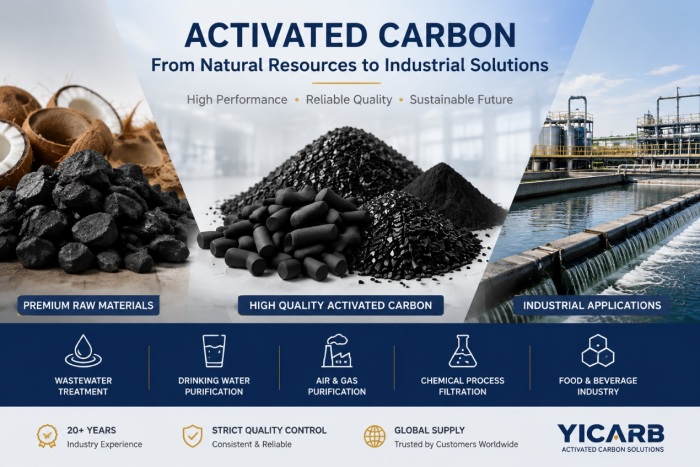
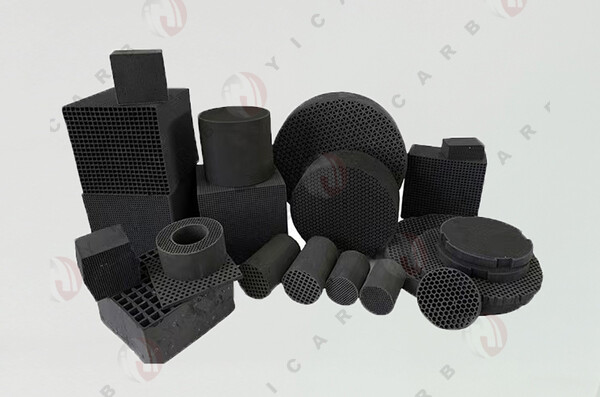
Figure 1: Activated carbon types and industrial applications infographic by YICARB
Activated carbon is a carbon-based adsorbent material produced from carbon-rich raw materials through a controlled activation process.
Common raw materials include:
Coconut shell
Coal
Wood
Other carbonaceous materials
During activation, the internal structure of the carbon material is modified to create a network of micropores, mesopores, and macropores. These pores significantly increase the available surface area, allowing activated carbon to capture and retain different types of contaminants through adsorption.
Unlike ordinary carbon materials, activated carbon has a highly developed porous structure that provides strong adsorption performance.
The final properties of activated carbon depend on several factors, including:
Raw material selection
Activation method
Pore size distribution
Surface chemistry
Manufacturing process control
Activated carbon works mainly through a process called adsorption.
Adsorption occurs when molecules from liquids or gases attach to the surface of activated carbon pores. Because activated carbon contains millions of microscopic pores, it provides a large surface area where contaminants can be captured.
The adsorption performance of activated carbon depends on:
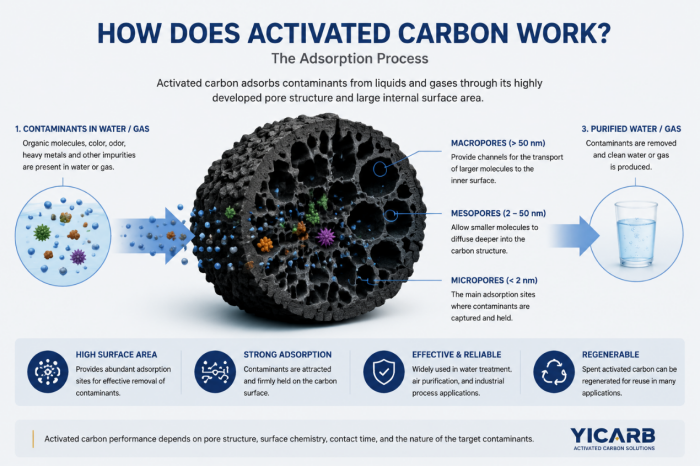
Figure 2: How activated carbon works: adsorption process and pore structure diagram
A larger internal surface area generally provides more adsorption sites. However, surface area alone does not determine performance. The relationship between pore structure and target contaminants is equally important.
Activated carbon pores are commonly classified into three categories:
Micropores (< 2 nm): Important for adsorption of small molecules
Mesopores (2–50 nm): Support the transport of molecules into carbon particles
Macropores (>50 nm): Provide pathways for larger molecules to enter the carbon structure
A balanced pore structure allows activated carbon to perform effectively in different applications.
The chemical properties of the carbon surface influence how strongly certain compounds are adsorbed.
Factors such as:
Surface functional groups
pH conditions
Target contaminant characteristics
can affect adsorption efficiency.
Activated carbon is commonly classified according to its physical form and production method.
Powdered activated carbon has a fine particle size and provides fast adsorption due to its large external surface area.
Typical applications include:
Wastewater treatment
Emergency contaminant removal
Decolorization processes
PAC is often selected when rapid adsorption is required.
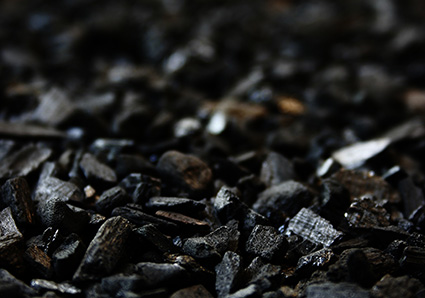
Granular activated carbon consists of larger carbon particles and is widely used in fixed-bed adsorption systems.
Typical applications include:
Industrial water treatment
Drinking water purification
Wastewater polishing
Gas purification
GAC offers advantages such as better flow characteristics and easier separation compared with powdered carbon.
Extruded activated carbon is produced by shaping carbon materials into cylindrical particles.
It is commonly used for:
Gas-phase purification
VOC removal
Solvent recovery
Its mechanical strength and uniform shape make it suitable for applications requiring stable airflow performance.
Different applications require different activated carbon properties. Important performance indicators include:
Iodine value is commonly used as an indicator of micropore development and adsorption capacity.
A higher iodine value generally indicates a greater amount of microporous structure, which can be beneficial for adsorption of smaller molecules.
However, iodine value should always be evaluated together with application conditions and target contaminants.
BET surface area measures the total available surface area of activated carbon.
It provides information about the development of the porous structure but does not represent actual application performance alone.
Ash content and moisture can influence activated carbon performance and handling characteristics.
For industrial applications, controlling these parameters helps maintain consistent product quality.
For applications involving repeated handling, transportation, or long operating cycles, mechanical strength is an important consideration.
Strong carbon particles can reduce:
Carbon breakdown
Fine particle generation
Material loss during operation
Activated carbon is used across many industries due to its adsorption capabilities.
Activated carbon is widely used in industrial wastewater treatment to remove:
Organic compounds
Color bodies
Trace contaminants
Chemical residues
In many treatment systems, activated carbon is used as a polishing step after primary and biological treatment processes.
Activated carbon is commonly applied in water purification systems to improve water quality by reducing unwanted substances that affect taste, odor, and chemical characteristics.
Activated carbon can adsorb various airborne pollutants, including:
VOCs
Odors
Industrial gases
Its performance depends on pore structure, surface chemistry, and operating conditions.
Activated carbon is also used in applications such as:
Solvent recovery
Product purification
Decolorization
Process filtration
Choosing activated carbon requires understanding the specific application requirements.
Important factors include:
Different contaminants require different pore structures and adsorption characteristics.
Factors such as:
Temperature
Flow rate
Contact time
Solution chemistry
can influence adsorption performance.
Key parameters to evaluate include:
Iodine value
BET surface area
Particle size distribution
Hardness
Ash content
Moisture
A suitable activated carbon should be selected based on actual operating conditions rather than a single performance indicator.
YICARB is a professional activated carbon manufacturer providing activated carbon solutions for industrial applications.
With manufacturing experience and technical expertise, YICARB focuses on consistent product quality, controlled production processes, and application-oriented carbon solutions.
Our activated carbon products are designed for industries including:
Wastewater treatment
Water purification
Industrial filtration
Environmental protection applications
By combining manufacturing capability with application knowledge, YICARB supports customers in selecting suitable activated carbon solutions based on their specific requirements.
Activated carbon is more than a highly porous carbon material. Its performance depends on the relationship between raw material, pore structure, surface characteristics, and application conditions.
Understanding these factors helps industries select the right activated carbon for effective adsorption performance and long-term operational stability.
For industrial applications, working with an experienced activated carbon manufacturer can help ensure consistent quality, reliable supply, and suitable product selection.