English
 français
 Deutsch
 Español
 português
 العربية
From contaminant fingerprinting to breakthrough control: a practical guide to designing carbon treatment around the wastewater, not around a single test number
Date: September 11, 2026 Author: YICARB Technical Expert (15+ years experience in activated carbon industry)
Activated carbon removes organic contaminants from wastewater by shifting dissolved compounds from the water phase onto a porous carbon surface. For industrial operators, organic contaminant removal from wastewater depends less on a single adsorption number than on matching contaminant behavior, water chemistry, carbon characteristics, and contact design. This guide focuses on wastewater polishing with activated carbon from a process-engineering perspective: which organics are likely to respond, why real wastewater matrices change adsorption behavior, how GAC and PAC should be used differently, and how treatment performance should be verified before full-scale operation.
The phrase “organic contaminants” covers a very broad chemical range. A wastewater stream can contain aromatic molecules, phenolic compounds, solvents, dyes, surfactants, oils, process additives, trace pharmaceuticals, pesticides, or partially degraded intermediates. These compounds do not interact with activated carbon in the same way.
Before selecting carbon, the treatment team should define the problem in terms of the compounds that actually matter. Is the objective to reduce a specific phenol, remove visible color, control an odor, lower a residual organic load, protect a downstream membrane, or polish water for reuse? A total parameter such as COD or TOC may be useful for monitoring overall organic loading, but it does not reveal which molecules dominate the adsorption demand.
A more useful starting point is a contaminant fingerprint. Important questions include molecular size, polarity, water solubility, concentration, ionization behavior, and whether other organics are present at much higher concentrations. These characteristics help determine whether adsorption is likely to be strong, weak, fast, slow, selective, or heavily affected by competition.
When activated carbon removes organic contaminants from wastewater, the target molecule does not disappear or become chemically destroyed by default. Instead, it transfers from the water phase to the carbon surface. The practical result is a lower dissolved concentration in the treated water and a progressively increasing contaminant loading on the carbon.
Two ideas are useful for understanding this process: affinity and accessibility. Affinity describes how strongly a molecule prefers the carbon surface relative to remaining in water.
Accessibility describes whether that molecule can reach suitable adsorption sites within the time available. A contaminant can have favorable affinity but still show poor removal if transport into the carbon is too slow for the actual hydraulic conditions.
This is why adsorption capacity and adsorption rate should not be treated as the same thing. A carbon may ultimately hold a useful quantity of a compound in a laboratory equilibrium test, yet a full-scale treatment system may see early breakthrough if contact time is short or if the available pore structure is difficult for the molecule to access.
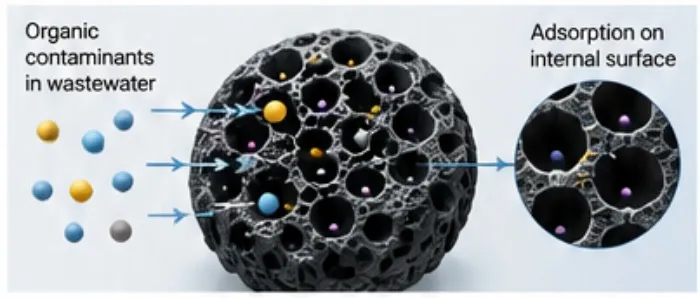
Figure 1: Organic molecules adsorbed inside activated carbon pores.
Activated carbon often shows strong affinity for many non-polar or moderately hydrophobic organic compounds, particularly when the molecular dimensions fit accessible pores. Aromatic structure can also favor interactions with graphitic regions of the carbon surface. However, these tendencies are not universal rules; wastewater chemistry and carbon surface properties can shift the result.
Highly water-soluble or strongly polar compounds can be more difficult to adsorb because they may prefer to remain associated with the water phase. Ionizable molecules can behave differently as pH changes. Larger molecules may require more accessible mesopore structure, while very small molecules can make better use of microporous adsorption volume when surface chemistry is favorable.
For this reason, “high surface area” is not enough as a selection statement. Two carbons with similar BET surface area can behave differently because their pore-size distribution and surface chemistry are different. The most useful carbon is the one whose accessible structure matches the target organic mixture.
Real wastewater is rarely a single-solute system. The target contaminant may represent only a small fraction of the dissolved organic material reaching the carbon. Other compounds can occupy adsorption sites, compete for pore space, or create surface fouling.
This competition helps explain why carbon life in plant operation can be shorter than expected from a clean-water laboratory test. Natural organic matter, surfactants, oils, residual polymers, soluble by-products, and other process chemicals may all contribute to the total adsorption demand. Suspended solids can add a different problem by coating the carbon bed, increasing pressure loss, or limiting contact with the internal surface.
Upstream treatment therefore has a direct influence on carbon economics. Removing solids, free oil, or easily biodegradable organics before the carbon stage can reserve more useful adsorption capacity for the compounds that are difficult to remove by other means. In many industrial systems, the question is not simply “Can carbon adsorb this contaminant?” but “What else reaches the carbon at the same time?”
For continuous wastewater polishing with activated carbon, granular activated carbon (GAC) is often operated in a fixed bed. As water enters the bed, the upstream portion of the carbon begins to load first. A zone of active adsorption develops and moves through the bed as operation continues.
This moving adsorption zone is important because the whole bed does not become exhausted at once. When the zone reaches the outlet, the concentration of the monitored contaminant begins to rise. This is breakthrough. The operating objective is normally to detect and manage breakthrough before the treated-water limit is exceeded.
A good GAC design therefore requires more than choosing a carbon grade. Bed depth, flow distribution, contact time, influent variability, pressure drop, sampling points, and the replacement or regeneration strategy all matter. Where continuity is critical, lead-lag vessels can provide an operational buffer: the first vessel carries most of the loading while a second vessel provides additional protection before discharge or reuse.
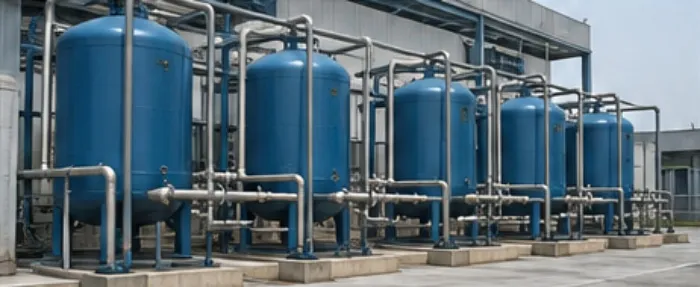
Figure 2: GAC vessels used for industrial wastewater polishing.
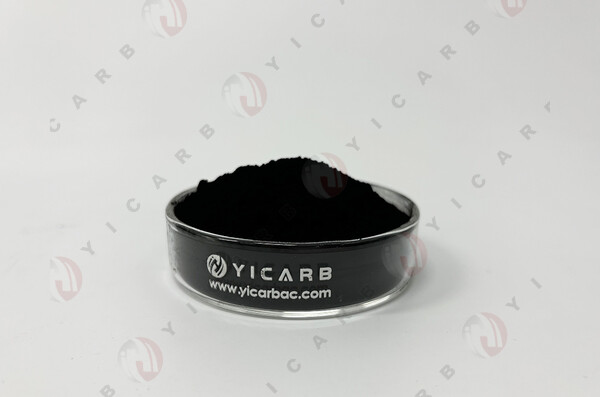
Powdered activated carbon (PAC) solves a different operating problem. Instead of containing carbon in a fixed bed, PAC is mixed directly with wastewater and then removed in a downstream solids-separation step.
This can be valuable when the organic load is intermittent, seasonal, or difficult to predict. PAC dosage can be adjusted as conditions change, which makes it useful for shock events, temporary polishing, or processes where installing a permanent GAC system is not justified.
The trade-off is that PAC creates a carbon-containing solids stream that must be separated and managed. Its effectiveness depends on dispersion, dose, mixing energy, available contact time, and the downstream ability to capture fine carbon. For this reason, the choice between GAC and PAC should be based on operating pattern and treatment objectives rather than on the assumption that one form is inherently more efficient.
Organic Problem | What to Evaluate | Useful Treatment Focus |
Color and dye residues | Molecular size, color source, competing organics | Pore accessibility and actual color reduction |
Phenols and aromatic organics | Concentration, pH, co-contaminants, outlet limit | Target-compound adsorption and breakthrough |
Solvents and process organics | Mixture composition and competition | Target-compound analysis, not COD alone |
Odor-causing organics | Specific odor source and low-concentration compounds | Monitor the odor-causing species or a relevant proxy |
Reuse polishing | Stable outlet quality and downstream sensitivity | Predictable breakthrough and operating continuity |
A practical selection program should reproduce the real wastewater as closely as possible. Clean-water values are useful for product consistency, but they cannot represent all matrix effects.
For a new application, the first step is to define the target: a specific compound concentration, color, odor, TOC, COD fraction, or another relevant quality parameter. Candidate carbons can then be compared in batch adsorption screening using the actual wastewater. The purpose is not only to identify which carbon removes the most material, but also to see how dose and contact time affect the result.
For GAC systems, column or pilot testing can provide additional information about breakthrough behavior, pressure drop, hydraulic stability, and the expected shape of the operating cycle. Testing should use representative water whenever possible, because a wastewater sample collected during unusually clean production can overstate carbon life.
The final selection should connect three types of evidence: product quality data, application testing, and operating constraints. This is more reliable than choosing a carbon solely because it has the highest iodine value, BET area, or another single specification.
When treatment performance declines, replacing the carbon with a “higher grade” product is not always the correct first response. Several system-level problems can produce the same symptom.
Early breakthrough can result from excessive flow, inadequate bed depth, a sudden increase in contaminant loading, channeling, or strong competition from other organics. Rising pressure drop may indicate suspended solids accumulation or biological growth rather than exhausted adsorption capacity. Poor PAC performance can result from insufficient mixing or too little contact time even when the carbon itself is suitable.
A useful troubleshooting sequence is therefore: confirm the influent composition, check hydraulic conditions, verify dosing or bed operation, compare current outlet data with the original treatment target, and only then determine whether the carbon properties are mismatched to the application.
Application Example - not a customer case study: Consider a specialty-chemical wastewater that has already passed through biological treatment. The overall COD is relatively stable, but the final effluent still shows intermittent color and a persistent process odor. Increasing biological residence time provides little additional improvement.
A carbon evaluation based only on bulk COD could miss the real treatment objective. A better approach would identify the residual color- and odor-causing fractions, screen candidate carbons against the actual effluent, and compare removal at realistic contact times. If a GAC bed is selected, monitoring should focus on the parameters linked to the actual problem so that breakthrough can be detected before the polishing objective is lost.
This example illustrates why organic contaminant removal from wastewater should be linked to a defined contaminant problem rather than to a generic expectation that carbon will reduce every organic parameter equally.
YICARB approaches wastewater polishing with activated carbon by first asking what must be removed, what remains in the water after upstream treatment, and how the carbon will be operated. Product specifications are then interpreted in that context.
For organic contaminant control, consistent carbon quality is important, but consistency alone does not guarantee suitability. Pore accessibility, particle size, mechanical behavior, adsorption affinity, hydraulic design, and regeneration or replacement planning must work together. Where the wastewater is complex, application testing can provide a more defensible basis for selection than a comparison of datasheet numbers.
Activated carbon is most valuable in wastewater treatment when it is used as a targeted adsorption process rather than as a generic “high-surface-area” material. The key is to understand which organics remain, how strongly they compete with the rest of the wastewater matrix, and how quickly they can reach useful adsorption sites under real operating conditions.
In practice, activated carbon removes organic contaminants from wastewater most reliably when contaminant chemistry, carbon structure, hydraulic design, and monitoring strategy are considered together. Effective organic contaminant removal from wastewater therefore begins with a defined treatment target, not with a single specification. For facilities considering wastewater polishing with activated carbon, combining representative testing with practical breakthrough control provides a stronger route to stable treatment performance.
This is the last one.