English
 français
 Deutsch
 Español
 português
 العربية
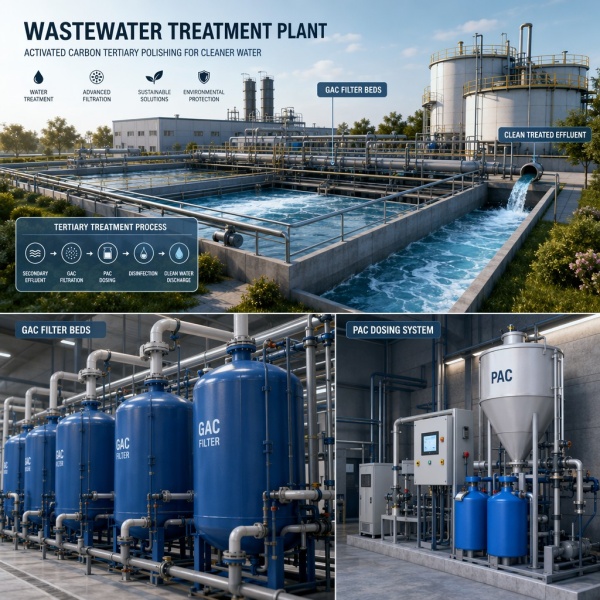
Figure 1: Modern wastewater treatment plant with activated carbon tertiary polishing stage for advanced contaminant removal.
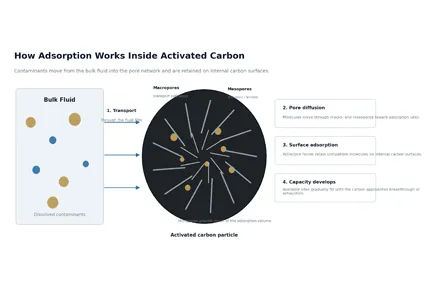
Abstract: As environmental regulations tighten globally, conventional biological wastewater treatment is increasingly inadequate for meeting stringent discharge limits on recalcitrant COD, trace organic micropollutants, and industrial colorants. Activated carbon—in both powdered (PAC) and granular (GAC) forms—has become the leading polishing technology for tertiary wastewater treatment. This technical brief examines the adsorption mechanisms that make activated carbon uniquely effective in wastewater applications and presents two case studies demonstrating full-scale compliance outcomes in industrial and municipal settings.
Biological treatment processes—activated sludge, MBR, SBR, and anaerobic digestion—are highly effective at removing biodegradable organic matter. However, they leave behind a residual fraction that activated carbon is uniquely positioned to address:
Recalcitrant COD: Soluble microbial products, humic acids, and refractory synthetic organics that resist biodegradation and contribute 30–80 mg/L of residual COD after secondary treatment.
Trace Organic Micropollutants: Pharmaceutical residues, endocrine-disrupting compounds, pesticides, and personal care products at ng/L to μg/L levels that pose ecological risks.
Color and Odor: Synthetic dyes, tannins, and odor-causing compounds that pass through biological treatment unchanged and affect public perception of treated effluent.
Industrial Toxicity: Heavy metal complexes, chlorinated solvents, and specialty chemicals that require adsorption rather than biodegradation for effective removal.
Parameter | PAC (Powdered Activated Carbon) | GAC (Granular Activated Carbon) |
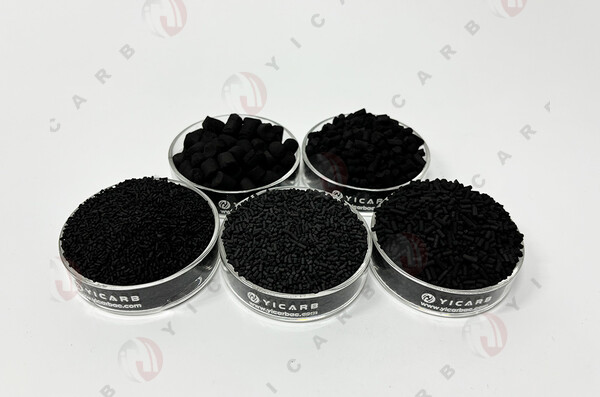
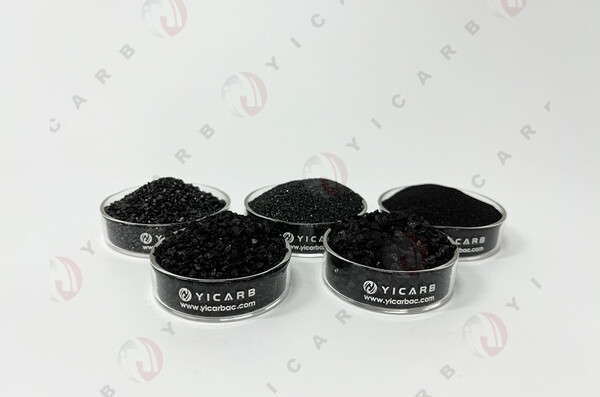
Particle Size | < 0.18 mm (powder, typically dosed as slurry) | 0.4–2.4 mm (granules packed in fixed beds) |
Dosing Method | Batch addition into aeration basin or dedicated contact tank | Fixed-bed contactors/columns with continuous flow |
Contact Time | Minutes to hours (suspended in mixed liquor) | 10–30 minutes EBCT (empty bed contact time) |
Regeneration | Single-use; spent carbon disposed with waste sludge | Thermally regenerated; 8–12 reuse cycles |
Ideal Application | Seasonal compliance peaks, shock loads, flexible dosing | Continuous polishing, micropollutant compliance, low OPEX |
For many modern wastewater treatment plants, fixed-bed activated carbon columns provide consistent contact time and efficient polishing under continuous-flow conditions. A combined PAC + GAC strategy is optimal: PAC handles variable loads and peak events in the biological stage, while GAC provides consistent polishing in a fixed-bed configuration downstream. YICARB supplies both forms and offers spent carbon reactivation services to minimize lifecycle costs.
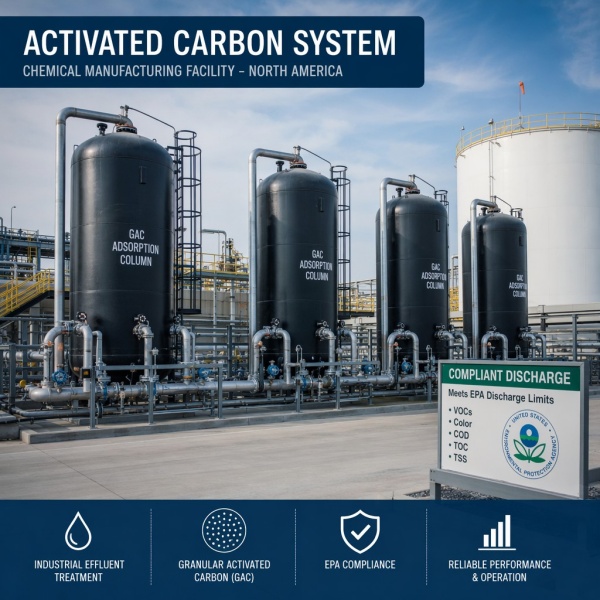
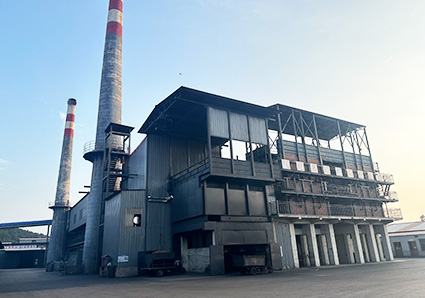
Figure 2: Chemical manufacturing wastewater treatment system with GAC adsorption for COD compliance in the United States.
Operational Challenge: A specialty chemical manufacturer in Texas operated an on-site biological treatment plant processing 800 m³/day of process wastewater containing solvents, intermediates, and cleaning agents. While the activated sludge system reliably reduced BOD to below the permit limit of 30 mg/L, residual COD consistently measured 180–220 mg/L—well above the renewed National Pollutant Discharge Elimination System (NPDES) permit limit of 100 mg/L. The recalcitrant COD fraction consisted primarily of chlorinated aromatic compounds and high-molecular-weight glycol ethers that resisted biodegradation. The facility faced a compliance deadline of 10 months and potential fines exceeding USD 75,000 per quarter for non-compliance.
The YICARB Solution: We designed a downstream GAC polishing system using YICARB IndusClean GAC (8×30 mesh, coal based activated carbon, Iodine 950 mg/g, Molasses Number 320). Two parallel fixed-bed adsorbers (8 m³ carbon each) were installed after the secondary clarifier with 18-minute EBCT. The coal-based carbon's enhanced mesopore volume was specifically selected for capturing the mid-to-high molecular weight chlorinated compounds identified in the facility's waste characterization study. A lead-lag column configuration with online COD monitoring ensured that treated effluent never exceeded the permit limit, even during production campaigns generating higher-strength wastewater.
Results: Discharge COD stabilized at 42–68 mg/L—comfortably below the 100 mg/L permit limit and representing a 72% reduction from the pre-GAC baseline. The facility achieved full NPDES compliance within 8 months of system installation. GAC bed life averaged 10 months between change-outs, with spent carbon thermally reactivated by YICARB at 92% activity recovery. The capital investment of USD 310,000 achieved payback within 14 months through avoided fines and reduced surcharge fees from the local wastewater utility. The environmental manager noted that the GAC system not only resolved the immediate compliance crisis but also provided operational flexibility to accept higher-value production contracts with more complex wastewater profiles.
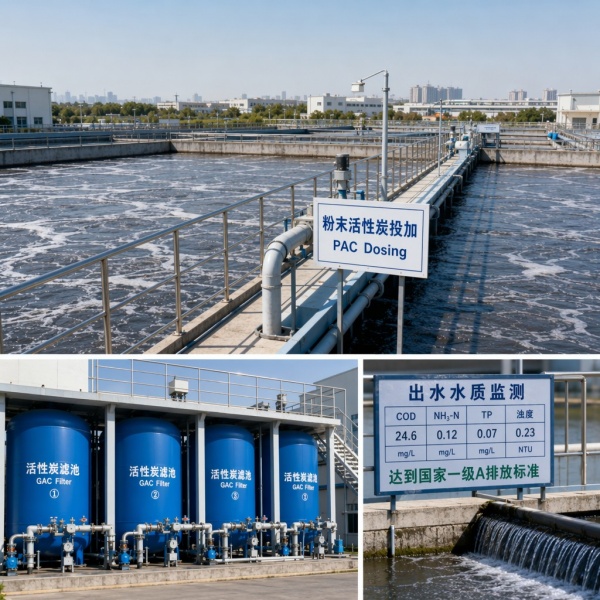
Figure 3: Municipal wastewater treatment plant in Zhejiang Province, China, with advanced activated carbon tertiary treatment.
Operational Challenge: A municipal wastewater treatment plant in Zhejiang Province, serving a population of 350,000 and treating 80,000 m³/day, was required to upgrade its treatment to meet China's new Class IA discharge standards (GB 18918-2002) and the emerging provincial micropollutant monitoring requirements. While the existing treatment train (primary sedimentation → anaerobic-anoxic-oxic → secondary sedimentation → UV disinfection) met conventional parameters, effluent COD averaged 48 mg/L against a new limit of 30 mg/L. Additionally, quarterly monitoring detected trace pharmaceutical compounds—including antibiotics and anti-inflammatory drugs—at concentrations that raised concerns under the Yangtze River Delta Ecological Protection Strategy. The treatment plant serving a major textile industry hub also faced seasonal color episodes from upstream industrial discharges that occasionally tinted the effluent with visible blue-green hues.
The YICARB Solution: We implemented a dual-stage carbon treatment strategy. Stage 1 added YICARB ColorTex PAC (Methylene Blue 15 mL/0.1g) at 20–30 mg/L directly into the aeration basin during color events, providing rapid adsorption of dye molecules before they reached the secondary clarifier. Stage 2 installed a GAC polishing system using YICARB AquaGuard GAC (coal-based, 8×30 mesh, Iodine 1050 mg/g) in four parallel fixed-bed contactors (15 m³ each) downstream of the secondary sedimentation tanks. The GAC contactors provided 22-minute EBCT for consistent removal of residual COD and trace organics. An online UV254 analyzer was integrated for real-time monitoring of organic breakthrough, enabling predictive carbon change-out scheduling.
Results: Effluent COD was reduced from 48 mg/L to 14–19 mg/L—a 63% improvement and well within the 30 mg/L Class IA standard. Color events, which previously occurred 6–8 times per year with each lasting 3–5 days, were fully controlled by the on-demand PAC dosing within 4 hours of detection. Pharmaceutical micropollutants were reduced by over 85% across monitored compounds. The treated effluent quality enabled the local water authority to supply reclaimed water for industrial cooling and landscape irrigation, generating an additional revenue stream of approximately CNY 2.8 million per year. The project was recognized by the provincial environmental protection bureau as a model installation for advanced municipal wastewater treatment.
Activated carbon has become an indispensable technology for wastewater treatment plants facing tightening discharge standards and increasing public scrutiny. Whether addressing industrial recalcitrant COD at a chemical plant in Texas or pharmaceutical micropollutants at a municipal facility in China, the engineering principle remains consistent: select the right carbon form (PAC, GAC, or both), size the system for the target contaminant profile, and monitor performance to optimize carbon life.
YICARB partners with industrial and municipal clients worldwide as one of the experienced activated carbon suppliers delivering delivering engineered carbon solutions backed by application testing, on-site commissioning support, and spent carbon reactivation services. The result is reliable compliance, predictable operating costs, and treated water that is safe for discharge, reuse, or environmental release.